Working on automotive smart windshield / window application to tint windows both in automotive mode and manual adjust. It must also be designed to block harmful UV rays and have minimum haze effect (< 5%).
Assume 12v power but looking to go beyond to make it wireless through combination of 1,000 mAh battery and / or supercapacitor combined with energy harvesting technology.
Another possibility might be to combine electrochromic windows and solar cells so that instead of uselessly reflecting away sunlight, darkened smart windows could soak up that energy and store it for later.
There are multiple Smart Glass Technology Innovators in the market – few listed below. Most of them use Electrochromic Technology (Dye or Film) or Nanotechnology:
Current in market technology is:
As can note below have investigated current technology options but none provide the groundbreaking technology which can make it a MUST HAVE.
Application is simple once you get the correct size film from them with translucent conductive glue and electronic circuits.
NOTES:
1. The bus bar (copper strip with the electrodes) is approximately 1/4” wide. It can be installed on any edge.
2. Edge where the electrodes are placed must be covered by 3/4” of nonconductive tape or trim under the electrodes.
3. If you must make a hole in the film, be sure to leave a minimum 1/2” of unaltered film between the hole and the edge of the film.
4. Max. 3/8” empty space between hole and PDLC matrix.
For more on InvisiShade Technology Application in Automotive contact support@invisishade.com.


Business Case for Translucent Visor w/HUD:
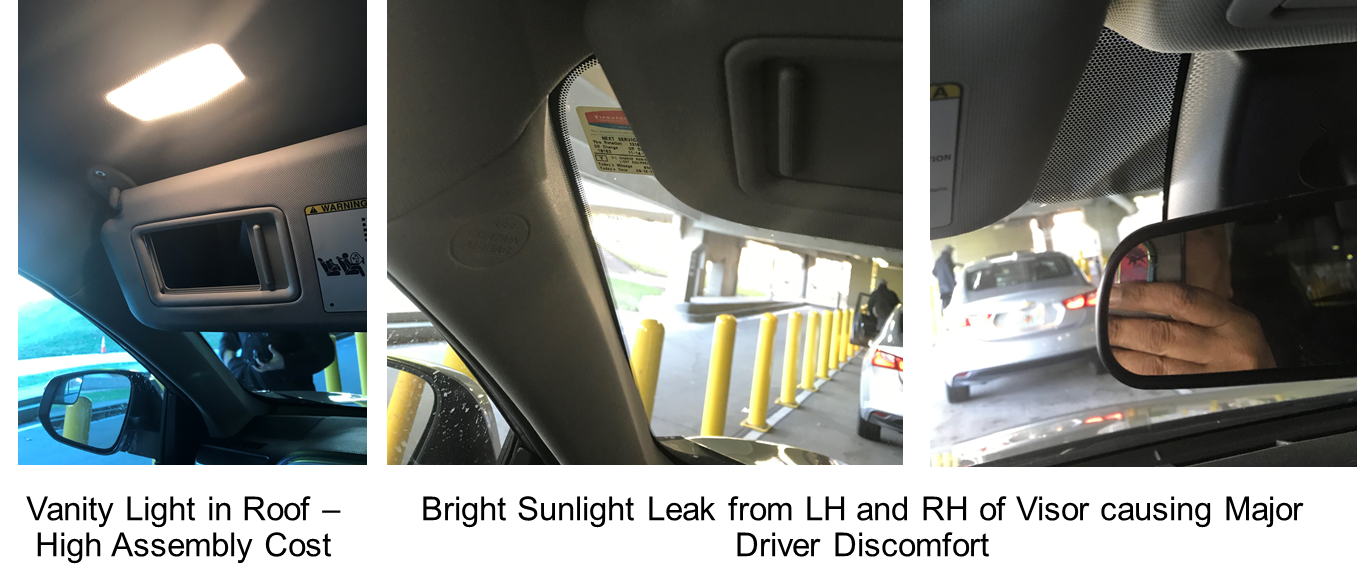
Here are examples of current Visor design which has not changed in the last 4 decades. It is basic with under 50% customer satisfaction based on information gathered by CETAS. Between all OE’s it really adds no real value other than that envisioned in 1954! There really no functional difference, I understand, between all Visors; even the high-end Tesla Visor also shown below.
There are technology options ideally suited for enhanced function for the Visor and enhance customer satisfaction coupled with higher social media conversation / interaction brining huge market value to OE’s.
The three technology enhanced options are:


In automotive applications the Sun Visor is probably the most basic component assembly which has not changed in decades (Tesla being the exception). Design HMi core competence in Visor Design is limited and one of the companies with extensive experience and core customer on global basis is Daimay Automotive ( http://en.daimay.com/).
Key Feature Adds for Translucent Sun Visor
As shown below in applications for next generation eye glass – most attributes will be needed in translucent automotive visor.
UV Coating
Anti-Reflective Costing
Polaroid Lens Technology
Anti-Fog Coating
Hydrophobic Coating
Toughened Glass
Oleophobic Coating
Anti-Scratch Coating
HUD Display Coating
Just Two Automotive Sun Visor Flaws that results in customer dissatisfaction of more than 50%+
Currently most automotive Sun Visors are essentially similar designed to block out the high glare of sunlight and vanity mirror.
Key components of most current Sun Visors are:
Apart from the Tesla Visor all others have been designed in as a commodity meeting no feature or design improvement. Current Visors have two distinct short-comings:
There are some aftermarket Translucent Visors but integration over In Car Visor is not easy.
Below is example of high-end Visor with three major functional modules (solar cells, intelligent control module, liquid crystal screen). Solar cells have two roles – perceive the light intensity as the light sensor and to convert light energy into electrical energy.
Intelligent control module uses the electrical energy to control the rotation of liquid crystal molecules, the result of liquid crystal molecules rotating is the brightness of the liquid crystal screen changes.
The stronger the outside light, the greater the power, the greater the rotation angle of the liquid crystal molecules, the darker the liquid crystal screen, on the contrary, the weaker the outside light, the more transparent the liquid crystal screen. Liquid crystal will automatically adjust brightness.
Design HMI in partnership with major automotive innovator is working to develop next generation visor with feature and greater functionality for improved in car driver and passenger experience.
Target timing to complete design for next generation Visor by Mid-2019.
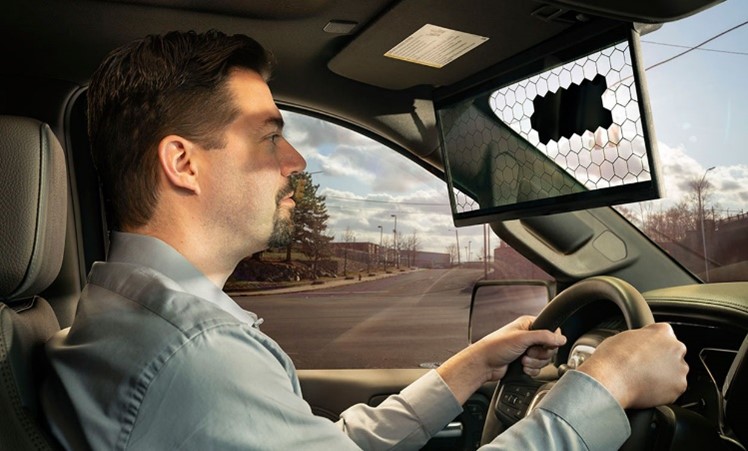
The liquid crystal display blocks the sun in just the right spots. An AI-enhanced liquid crystal display (LCD) screen that links with a driver-monitoring camera to keep the sun out of your eyes without blocking the outward view.
The visor links a simple, honeycomb-pattern LCD screen, reinforced with polycarbonate, with a driver-facing RGB camera and an electronic control unit (ECU) running an algorithm and AI program.
The camera detects a driver’s face—eyes, nose, forehead—and the shadows the sun creates on the face. AI tracks those facial landmarks, along with
the sun’s relative position in the vehicle environment. Analyzing faces and shadows, the system essentially works backward, figuring out where light is entering the vehicle, no matter in which direction the car is headed.
That AI employs neural networks and histogram of oriented gradients methods, with Bosch-trained models for those two AI techniques. Algorithms for shadow detection and to steer the screen are trained using domain-specific input data, e.g., real-world data from the vehicle.
A patented algorithm pinpoints the driver’s eye position, and selectively darkens or lightens portions of the screen to ensure drivers aren’t blinded. The proprietary algorithm determines the shadows and where to block corresponding sections of the visor surface. 90 percent of the visor field remains transparent at all times, no matter the sun’s intensity or angle, which eliminates that annoying limbo where drivers constantly adjust their visor or try to peer under or around it.
One cool bit is that, with driver-monitoring cameras now gaining traction in luxury cars, including the Cadillac CT6, to safely manage semi-autonomous driving functions, the Virtual Visor might become an affordable add-on: If a camera and computing power is already onboard, all that’s needed is the visor and more lines of code.
CETAS is a technology application development company to identify, design, and validate feature enhanced products for automotive oems and customers.
Sign Me Up for CETAS news.